Convert mL to oz for Smoothie, Coffee & Water Measurements
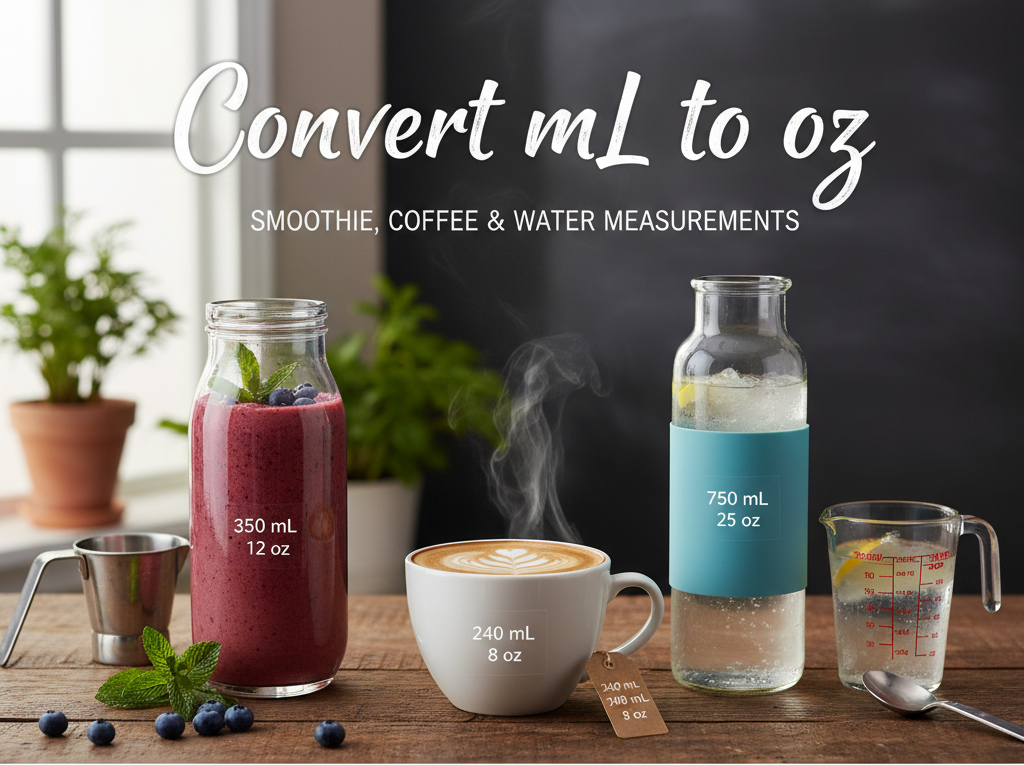
Whether you’re making a smoothie, brewing coffee, or tracking your water intake, accurate liquid measurement makes all the difference. Even a small mistake can change the taste, texture, or consistency of your drink.
The mL to oz conversion, short for milliliters to ounces, connects two common measurement systems used around the world: the metric system, which uses milliliters and liters, and the imperial system, which measures liquids in fluid ounces.
Understanding how to switch between these two systems saves time, prevents errors, and keeps your results consistent. Whether you’re a student, chef, barista, or fitness enthusiast, knowing how to convert mL to oz is one of the most practical and useful skills you can learn.
Understanding the Basics: Milliliters and Ounces
Before we look at conversion formulas, it’s important to know what these units represent.
- Milliliter (mL): A metric unit of volume equal to one-thousandth of a liter. It’s the most common way to measure small liquid volumes globally.
- 1 milliliter = 1 cubic centimeter (1 mL = 1 cm³).
- 1 milliliter = 1 cubic centimeter (1 mL = 1 cm³).
- Fluid Ounce (oz): A unit of volume used in both the U.S. customary system and British imperial system. The two definitions are slightly different:
- 1 U.S. fluid ounce = 29.5735 mL
- 1 U.K. (Imperial) fluid ounce = 28.4131 mL
- 1 U.S. fluid ounce = 29.5735 mL
Because of this small difference, it’s important to know whether your recipe, bottle, or device uses U.S. or U.K. ounces. Most modern kitchen and beverage measurements use U.S. fluid ounces.
The mL to oz Conversion Formula
The conversion between milliliters and ounces is straightforward when you know the conversion factor.
Formula for U.S. Fluid Ounces:
oz = mL ÷ 29.5735
Formula for U.K. Fluid Ounces:
oz = mL ÷ 28.4131
Example Calculation:
Convert 500 mL of water into U.S. fluid ounces:
oz = 500 ÷ 29.5735
oz = 16.91
So, 500 mL = 16.91 oz (U.S.)
This conversion applies to smoothies, coffee, water, and any other liquid-based measurement.
Quick Reference: mL to oz Conversion Chart
| Milliliters (mL) | U.S. Fluid Ounces (oz) | U.K. Fluid Ounces (oz) |
| 50 | 1.69 | 1.76 |
| 100 | 3.38 | 3.52 |
| 200 | 6.76 | 7.04 |
| 250 | 8.45 | 8.80 |
| 500 | 16.91 | 17.60 |
| 750 | 25.36 | 26.40 |
| 1000 | 33.81 | 35.20 |
Keep this table handy whenever you’re converting beverage or recipe measurements between milliliters and ounces.
Why Convert mL to oz for Smoothies
Smoothies are the perfect example of how accurate liquid measurements can make or break a recipe. Too much liquid can make your smoothie thin and watery; too little can make it overly thick or difficult to blend.
Most blenders, especially those sold in the U.S., measure in ounces or cups, while many recipes found online use milliliters. Knowing how to convert mL to oz allows you to follow recipes from anywhere in the world with confidence.
Example 1:
A recipe calls for 250 mL of milk or plant-based liquid.
Convert to ounces:
oz = 250 ÷ 29.5735
oz = 8.45 oz
So, pour 8.45 ounces of milk for perfect smoothie consistency.
Example 2:
If you only have a blender marked in ounces and want to use 12 oz of liquid:
mL = 12 × 29.5735 = 354.88 mL
That means 12 oz = 354.88 mL ideal for a single large smoothie or two small servings.
Pro Tip: When making multi-ingredient smoothies, remember that fruit and yogurt add liquid volume too. Using mL to oz conversion ensures balanced texture every time.
See also: Reducing Costs with Efficient Component Fabrication
Using mL to oz Conversion for Coffee
For coffee drinkers, precision equals perfection. Whether you’re measuring for a pour-over, French press, or espresso shot, using the correct liquid ratio determines flavor and strength.
Coffee recipes often use different units depending on origin U.S. baristas use ounces, while European coffee guides rely on milliliters. The mL to oz conversion unites both.
The Coffee Brewing Ratio
A typical brew ratio is 1:15 to 1:18 one gram of coffee for every 15–18 mL of water.
Example:
To brew a single cup of coffee using 240 mL of water:
oz = 240 ÷ 29.5735 = 8.12 oz
So, 1 cup (240 mL) equals 8.12 U.S. ounces.
Knowing this helps when scaling recipes or adjusting brew strength for multiple servings.
Barista Insight: Many espresso machines and coffee makers list water capacities in ounces. Using DigiCalc’s mL to oz converter makes it simple to adjust measurements without guesswork.
Why mL to oz Conversion Helps Track Water Intake
Hydration tracking has become a key part of fitness and health routines. However, most fitness apps and hydration goals (like “drink 64 ounces a day”) use ounces, while reusable bottles and European products list milliliters.
Converting mL to oz lets you stay on track no matter which system you prefer.
Example:
Daily water goal = 64 oz
mL = oz × 29.5735
mL = 64 × 29.5735 = 1891.7 mL
That means you need about 1.9 liters (1900 mL) of water daily to meet your 64 oz target.
Common Water Bottle Conversions
| Bottle Size (mL) | Equivalent in Ounces (U.S.) |
| 250 mL | 8.45 oz |
| 500 mL | 16.91 oz |
| 750 mL | 25.36 oz |
| 1000 mL (1 L) | 33.81 oz |
| 1500 mL | 50.72 oz |
With this guide, you can quickly calculate how many bottles to drink daily for proper hydration no confusion, just precision.
Common Conversion Mistakes to Avoid
While converting mL to oz is straightforward, there are a few common pitfalls:
- Mixing U.S. and U.K. systems – Always verify which “ounce” is being used. Most kitchen and beverage conversions use U.S. ounces.
- Rounding too early – Keep at least two decimal places for accuracy, especially in recipes and scientific applications.
- Inconsistent units – Don’t mix mL and oz in the same calculation without converting all values first.
- Estimating instead of converting – Relying on estimation can change recipe taste and results. Use a precise converter like DigiCalc for best accuracy.
Conclusion:
Whether you’re blending a smoothie, crafting a coffee, or monitoring your hydration, knowing how to convert mL to oz ensures accuracy, consistency, and better results every time. This conversion connects recipes, cultures, and measurement systems allowing you to follow any recipe or routine effortlessly.
Instead of estimating or using unreliable charts, simplify your process with DigiCalc mL to oz calculator. Our tool delivers instant, accurate, and reliable conversions tailored for your kitchen, gym, or classroom needs.